
Workplace capability model
What a digital workplace has to deliver, in three layers, without naming products. An interactive version adds a Microsoft view and three lenses.
 by Phillip Büchler
The model lists what a digital workplace has to deliver, in three layers: work surfaces (what people use), access and endpoints (where people work) and the control plane (what keeps it running and under control). Business applications sit outside the boundary and connect through identity.
The capabilities are vendor-neutral. The interactive version puts one product overlay on top, a Microsoft-centric estate, plus three lenses. It leaves out business applications, cost figures and any recommendation for a provider.
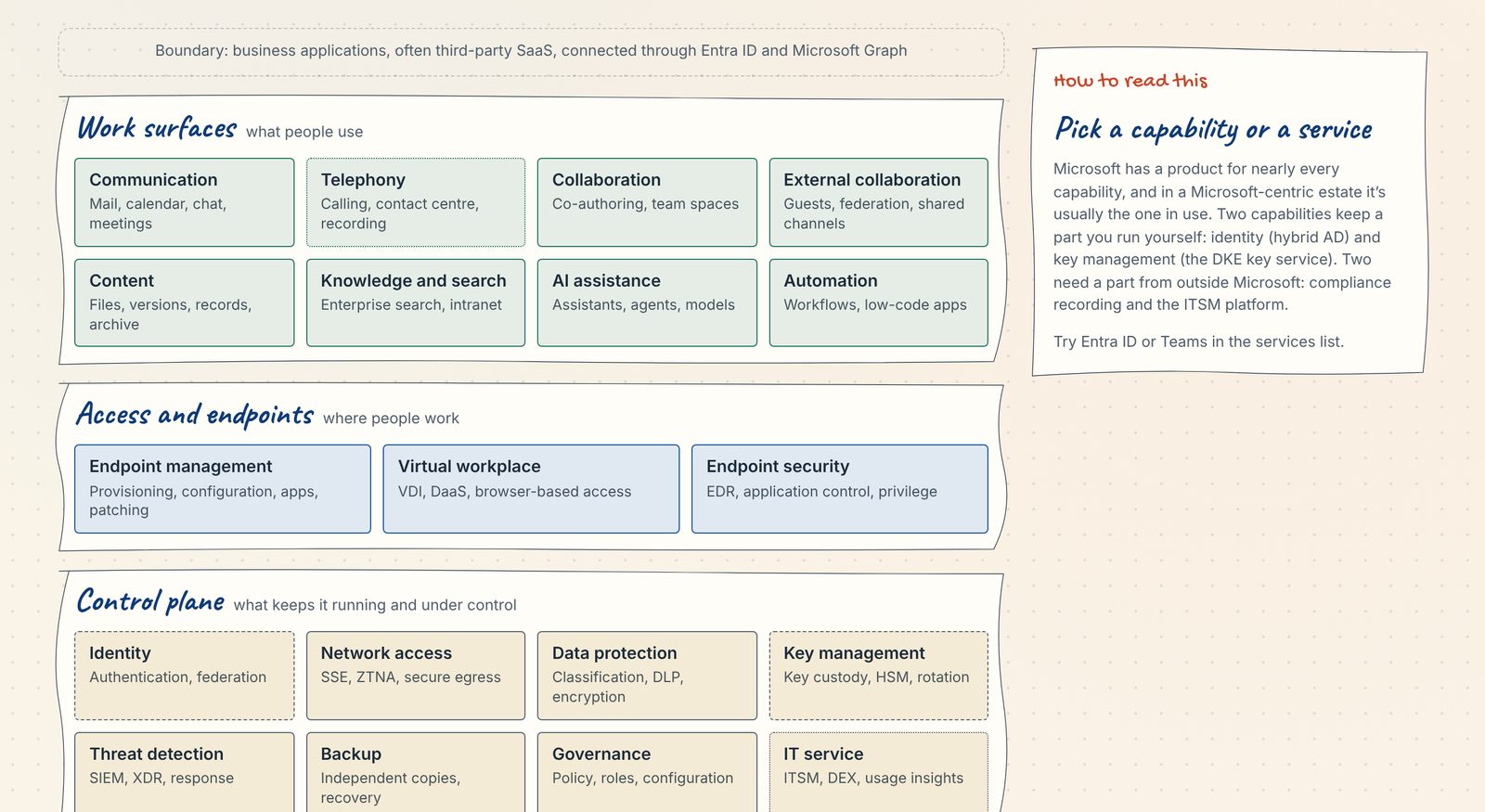
The image opens the interactive version.
Views
| View | What it shows |
|---|---|
| Microsoft services | Which Microsoft services deliver which capability, and what depends on them |
| Exit effort | How hard each capability is to move off Microsoft, split into retraining users and technical rebuild |
| Sensitivity | What each sensitivity level needs, capability by capability |
| Options: what you keep | Which functions you keep, keep in reduced form or lose with each option, against the Microsoft 365 cloud baseline |
Ratings in the exit effort, sensitivity and options views are proposals for discussion, not measurements. Product facts change often; check the date above.
Used in
Changelog
| Date | Change |
|---|---|
| 12 Nov 2026 | v0.3: moved into the architecture library. “Sensitivity” replaces “data class”. The options view measures against the Microsoft 365 cloud baseline. |
| 5 Nov 2026 | First published with the Sovereign Workplace hub, at /workplace-capability-model/. |